Italy Fines Meta €805M Over Facebook Gallery Privacy
Italy’s Garante fined Meta €805 million over Facebook’s Android gallery-suggestion feature, citing consent that was not specific or informed.

Italy’s data-protection authority has fined Meta Platforms Ireland €805 million after finding that Facebook’s Android app accessed users’ photos, videos and related metadata without obtaining specific, informed consent.
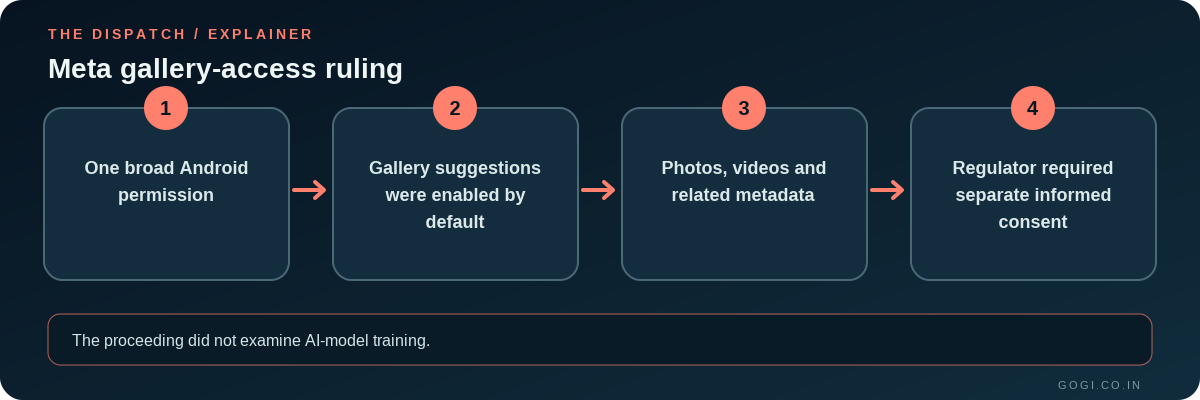
The decision, issued on 14 November 2026, concerns a feature called “Get suggestions from gallery when browsing Facebook”. It suggests images and videos from a phone’s local gallery while a person is browsing Facebook, allowing them to choose material to share. The Italian regulator says the feature was available from 2023 and that the app’s consent process did not adequately explain this distinct access to personal content.
The ruling is significant because the authority treats access to a phone’s gallery as a separate privacy purpose, not something automatically covered by a broad Android permission granted for other app functions.
What the regulator says happened
The Garante says the Facebook app accessed photographs, videos and associated metadata stored on Android devices used by people in Italy. It found that the gallery-suggestion feature was enabled by default and relied on a general device permission that did not clearly separate gallery access from other functions.
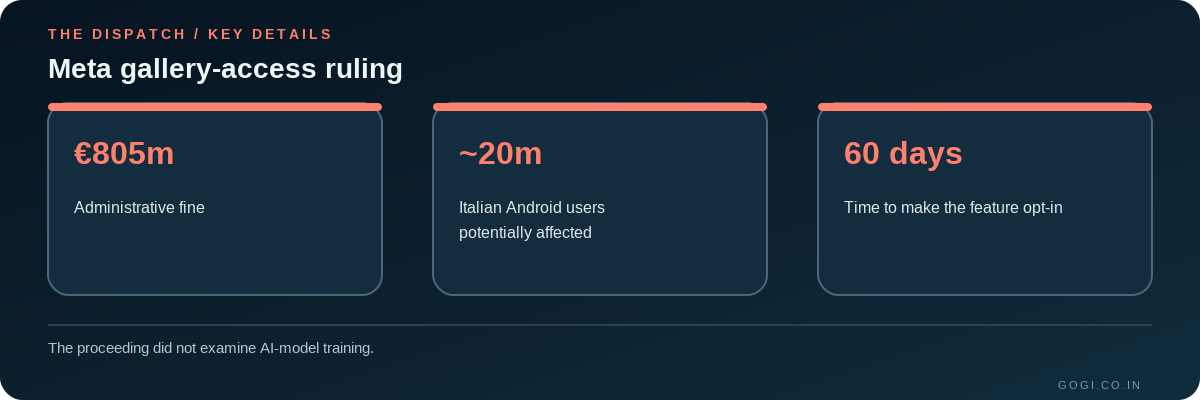
The authority estimates that about 20 million Android users in Italy could have been affected. It said the feature’s activation and consent design did not give users enough information to make a free and informed choice before their gallery content was accessed.
The regulator imposed the €805 million penalty on Meta Platforms Ireland Limited. It said the amount reflected the number of people potentially affected, the duration of the conduct, a previous 2019 measure involving the company and what it described as limited cooperation during the investigation. The fine is approximately 0.47 per cent of Meta’s global turnover, according to the authority.
What Meta must change
The Garante ordered Meta to make the gallery feature opt-in by default and obtain separate, specific consent for it. Users must be told what the feature does, that it requires access to their gallery and how they can disable it.
The order gives Meta 60 days to make the required changes. The company must also report the initiatives it has begun within 30 days and the measures it has implemented within 90 days.
The authority also rejected Meta’s argument that the matter should fall exclusively under the Irish regulator. It said the relevant ePrivacy rules do not use the EU’s one-stop-shop mechanism in the way Meta argued.
Meta says it will appeal
Meta has said it will appeal and strongly disagrees with the regulator’s assessment and the size of the penalty. In a statement reported by Reuters, a company spokesperson argued that users must grant device permission before the feature can work and can change that permission in Android settings. Meta described the function as a way to help people share photos and videos.
The regulator’s decision and Meta’s response therefore disagree on what the device-level permission means. The Garante’s position is that a general permission does not replace a separate, informed choice for a distinct purpose such as surfacing gallery content while browsing.
The appeal has not been resolved. The fine should therefore be described as an administrative decision that Meta intends to challenge, not as a final judicial ruling.
The decision is not about AI training
One important boundary is easy to lose in the wider debate about social-media privacy. The Garante explicitly says this proceeding did not examine whether gallery content was used to train artificial-intelligence models. Meta denies that it used the content for AI training.
The authority separately reserved the right to examine a newer feature launched in 2026 that allows gallery content to be processed in the cloud. That is a distinct matter and should not be folded into the findings about the Android gallery-suggestion feature.
The supported conclusion is narrower: Italy’s regulator found that Facebook’s Android gallery-suggestion feature accessed personal content without sufficiently specific consent, ordered changes to how it is enabled and explained, and imposed an €805 million fine. Meta disputes the ruling and intends to appeal.
Sources
- Italian Data Protection Authority: decision and order against Meta, 14 November 2026 — primary source for the findings, legal basis, affected users, deadlines and the explicit statement that AI training was outside this proceeding.
- Reuters: Italy fines Meta $887 million over Android users’ data access — independent reporting on the decision and Meta’s stated intention to appeal.
- Euronews: Italy fines Meta €805m for accessing Facebook Android photos and videos without consent — reports the company’s response.
- Associated Press: Meta fined $887 million in Italy over Android gallery photos and videos — independent account of the ruling and its scope.
AI-assisted content
This story was drafted and/or edited with AI assistance and reviewed before publishing.
Explore more topics
Related stories


OpenAI and Cisco Launch Shirudo, an Experimental Runtime Shield for Linux
OpenAI and Cisco have open-sourced Shirudo, a project designed to deploy temporary protections while teams prepare software patches. Its first public demonstration is narrow, and the project’s own documentation says it is not ready for production.

Multi-Tenant Architecture in SaaS: Isolation Models, Security and Scaling
A practical guide to multi-tenant architecture in SaaS: compare silo, bridge and pooled models, design tenant-aware identity and data access, and prevent cross-tenant leaks across databases, APIs, caches, storage and background jobs.