Apple Launches US Study on How People Use AI for Health
Apple’s Health AI Usage Study with OpenEvidence will examine how US adults use AI for health information. It’s research, not a new Health feature.
Apple has launched a research study with medical-information company OpenEvidence to examine how people use artificial intelligence when they have health questions. The programme is designed to gather research data about the role AI plays in people’s health-information decisions; it is not a general release of an AI-powered Health app or a new clinical service.
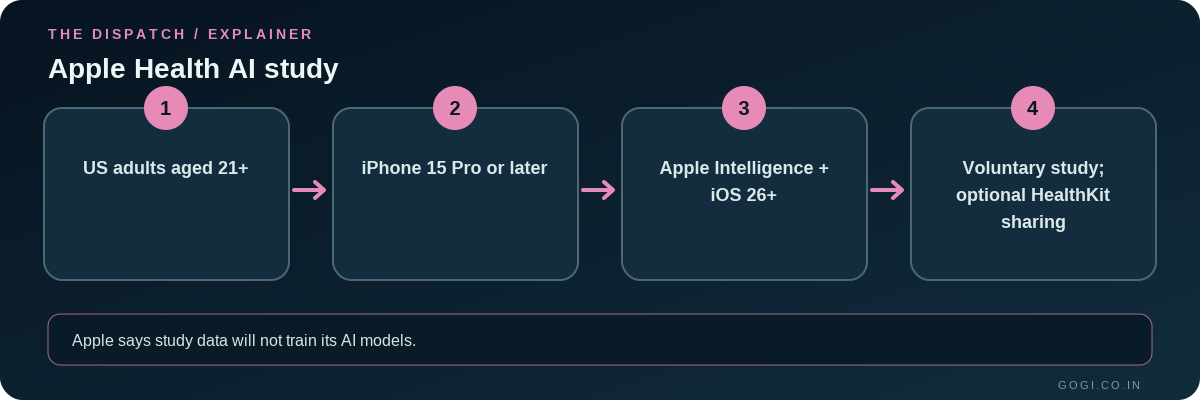
Apple says the study could enrol up to 200,000 participants in the United States. The company is inviting eligible adults to take part through a dedicated study app and has framed the project as a way to better understand how people seek and use health information with AI tools.
What the study is designed to examine
The study focuses on how people use AI when asking health-related questions and how AI-generated information fits into their wider health-information habits. OpenEvidence is involved as the medical-information partner.
Apple says the study app will let participants ask everyday health questions and review answers supported by citations to peer-reviewed clinical literature. The research is intended to examine how people use AI health information, including how it may help them prepare for conversations with clinicians. These are study functions, not a promise of diagnosis or treatment.
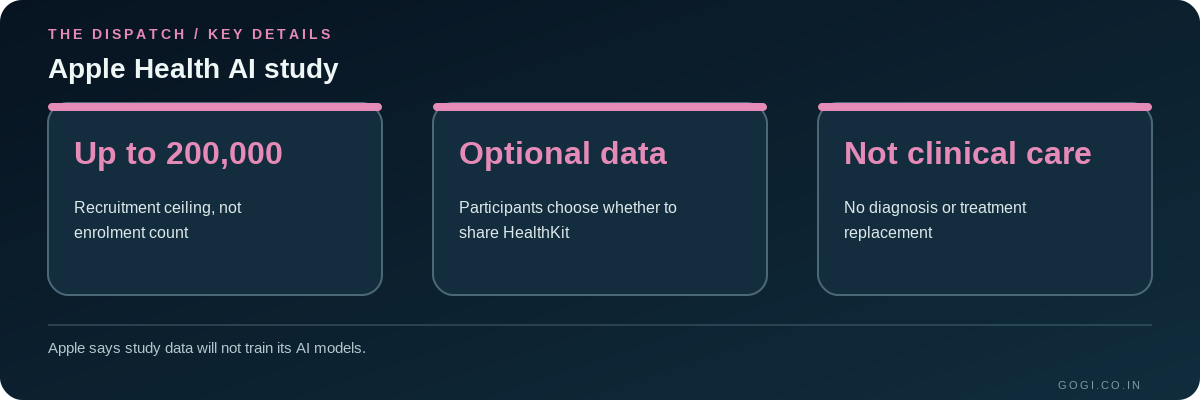
The programme is intended to produce research insights about the use of AI for health information. It should not be confused with a feature that diagnoses conditions, replaces a clinician or automatically interprets a participant’s medical record.
Apple’s announcement describes a voluntary study, with participants deciding whether to share health information from Apple Health through the study’s permissions. That distinction is important: participation and data sharing are choices, not an automatic consequence of installing the regular Health app.
Who can take part
Apple says the initial study is for adults aged 21 and older in the United States, with compatible Apple hardware and software requirements. Its announcement specifies an iPhone 15 Pro or later that supports Apple Intelligence and a current supported version of iOS.
The company says the study may involve up to 200,000 participants. The figure is a recruitment ceiling, not a statement that 200,000 people have already enrolled or completed the research.
Participants should read the study information and consent materials before joining. The precise information collected, the permissions requested and the study’s retention rules should be assessed from those materials rather than inferred from the normal privacy settings of the Health app.
Apple’s privacy claims
Apple says data from the study will not be used to train its AI models. It also describes the study as voluntary and explains that participants can choose whether to share HealthKit information.
Those are company claims about the study’s design and data use. They should be distinguished from the broader question of how every AI health service handles health information. OpenEvidence’s role, the study’s consent process and the data participants choose to share are all relevant to understanding the programme.
A research project involving health-related conversations can still reveal sensitive information even when it is not designed to replace clinical care. Participants should review the actual consent and privacy documents before deciding whether to contribute.
Why Apple is studying the behaviour
Health questions are already a common use case for general-purpose AI assistants, but the risks differ from ordinary information searches. People may treat a confident answer as medical guidance, omit important context or fail to recognise when a symptom requires professional evaluation.
A study that measures how people use these tools could help researchers understand when AI is useful, where users misunderstand its limits and what kinds of safeguards or sources matter. The announcement itself does not establish that AI health answers improve medical outcomes, reduce costs or replace consultations.
The research may provide evidence about user behaviour and preferences. It should not be treated as validation of an AI system’s clinical accuracy.
A research app, not a new Health product
Apple’s announcement is notable because it brings the company into a more formal study of AI and health information. But the immediate product is a research programme with eligibility requirements and consent choices, not a broad new feature in the Health app.
The results will matter more than the recruitment headline. Until the study publishes findings, claims about how safe, effective or beneficial AI health assistants are should remain open questions.
Sources
- Apple Newsroom: Apple launches research study to explore the use of AI for health — primary source for the study, eligibility, participation and Apple’s privacy statements.
- TechCrunch: Apple launches new app to study how people use AI for health — independent reporting on the study and its rollout.
AI-assisted content
This story was drafted and/or edited with AI assistance and reviewed before publishing.
Explore more topics
Related stories



OpenAI and Cisco Launch Shirudo, an Experimental Runtime Shield for Linux
OpenAI and Cisco have open-sourced Shirudo, a project designed to deploy temporary protections while teams prepare software patches. Its first public demonstration is narrow, and the project’s own documentation says it is not ready for production.