Anonymous-Branded Video Revives Global Blackout Rumour
An Anonymous-style video revived a global blackout claim after a November 17 prediction failed, mixing unrelated events and unverified evidence.
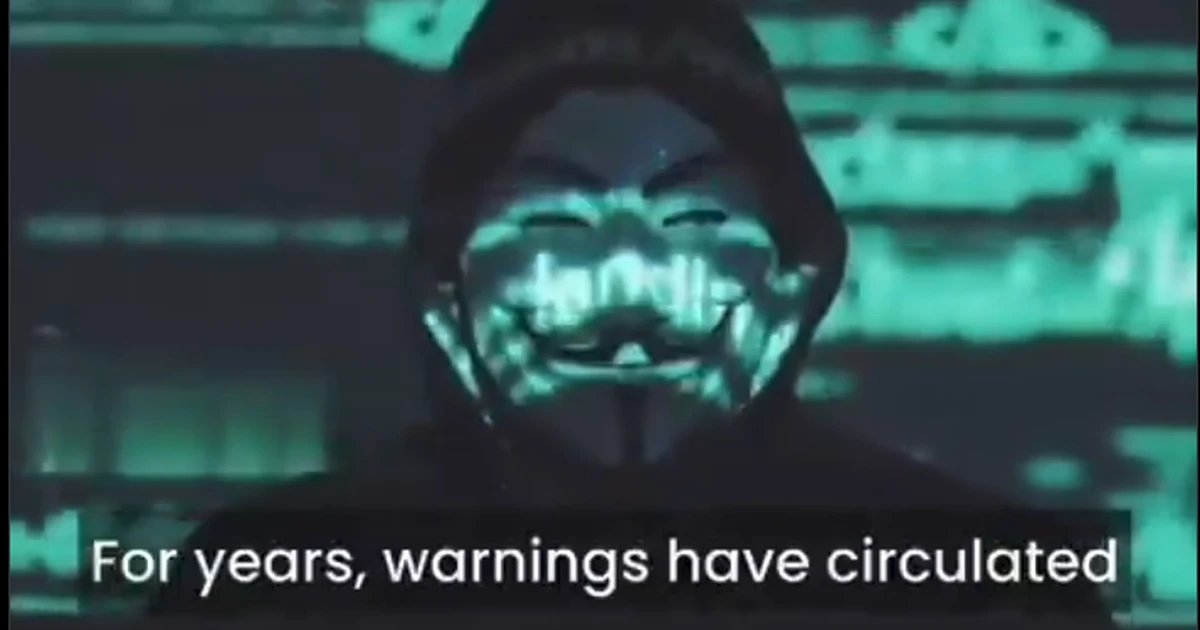
An X post shared with The Dispatch links to a video featuring an Anonymous-style masked figure and a warning that blackout concerns have circulated for years. It arrives after a separate prediction of a worldwide blackout on November 17, 2026, passed without the event described in viral posts.
The new video should not be treated as evidence that a blackout is planned. The linked X post could not be retrieved directly during reporting, so its full contents, original upload context and the identity of whoever produced it could not be independently verified. The image supplied with the post shows a masked figure and the on-screen words, “For years, warnings have circulated”; it does not establish that the speaker represents the wider Anonymous movement.
Video shared in the post supplied for this story. The post could not be independently retrieved during reporting; its authorship and full contents have not been authenticated. Watch the original post on X
— @c14english
If the embedded player does not load, open the original post on X.
The November 17 prediction was built around unrelated events
The earlier rumour combined a fictional television storyline with a real emergency-alert exercise and unrelated preparedness messages. Posts claimed that electricity, internet access and banking services would fail worldwide, in some versions for as long as 90 days.
The date coincided with a nationwide US Emergency Alert System test scheduled by the Federal Emergency Management Agency and the Federal Communications Commission. The FCC's September 16 public notice set the test for 2:20 p.m. Eastern Time on November 17, with December 3 as a backup date if the test had to be postponed. The test message was designed to identify itself as a test and tell the public that no action was required. It was distributed through participating radio and television broadcasters, not as a warning that the power grid would be shut down.
The Simpsons connection was also misrepresented. The episode cited in viral posts, “It's a Blunderful Life”, originally aired in November 2023 and depicts a fictional power failure in Springfield. It does not identify 2026 as the year of a real-world blackout. Fact-checkers found no evidence for the claimed global event.
With November 17 now past, the prediction did not materialise. That does not prove that large power outages can never happen; it does mean the specific date-based claim has failed.
A Microsoft 365 outage was not evidence of a cyberattack
The rumour also circulated alongside a disruption affecting Microsoft 365 services on November 12 and 13. Microsoft's incident record described a technical failure in systems responsible for establishing connections to Exchange Online. A latent software bug was exposed during network maintenance and traffic changes, causing requests to queue until affected servers exhausted processing capacity.
Microsoft's incident update explicitly classified the disruption as unrelated to cyber activity or AI agents. It was a service availability incident, not evidence that attackers had taken down the internet or electrical infrastructure.
Conflating an unrelated cloud-service outage with a prediction of a global blackout turns two different events into a misleading narrative. A software defect can interrupt access to online services without indicating that the electricity grid, banking system or global internet is under coordinated attack.
What a global blackout claim leaves out
Electricity systems are interconnected in some regions, and failures can cascade across connected networks. The International Energy Agency notes that cross-border interconnection can increase the risk that a major blackout in one jurisdiction spills into neighbouring systems. Regional blackouts are therefore a genuine infrastructure risk and require serious planning.
But the existence of interconnected grids does not mean the planet operates one unified electrical network that can be switched off by a single actor. Power systems are operated through multiple national and regional institutions, with different generation mixes, transmission networks, protections and operating procedures. A claim of a simultaneous worldwide blackout would require evidence far beyond a dramatic video or a date circulating on social media.
The same distinction applies to the internet. It is a network of independently operated systems and interconnections, not one central power switch. Disruptions can be severe and widespread, but a post predicting a total global shutdown needs verifiable evidence: a named threat, credible technical indicators, official warnings or independently corroborated incidents.
No such evidence has been provided in the X post supplied for this story, and the post itself was not retrievable for direct inspection.
The Anonymous label does not authenticate the warning
Anonymous is a decentralised hacktivist identity rather than a conventional organisation with a universally recognised leadership or membership register. Academic research describes it as a fluid collective in which different subnetworks may organise particular operations. That structure makes it difficult to establish whether a statement made under the name represents any broader group.
A Guy Fawkes-style mask, familiar graphics, distorted voice or the word “Anonymous” in a video are not proof of authorship. Without a verifiable account history, corroborating statements from established channels, or evidence connecting the video to a specific operation, the safest description is an “Anonymous-branded” or “Anonymous-style” video—not an official warning from Anonymous.
The same standard should apply to any future claims. A video can demonstrate that someone published a warning; it cannot, by itself, demonstrate that the event described is real.
What readers should do
There is no reason to prepare for a predicted worldwide blackout on the strength of this video. Routine household preparedness remains sensible: keep essential medicines and emergency contacts accessible, know how to receive local emergency alerts, and follow instructions from electricity utilities and public authorities during an actual outage.
Readers should be cautious about posts that attach a precise date to a catastrophic prediction, combine unrelated events, or urge people to share a warning without supplying verifiable evidence. Check the original notice behind any claimed alert test, look for statements from the relevant grid operator or emergency authority, and distinguish a local outage from a regional or international incident.
The November 17 prediction failed. The newly circulated video does not change that record. Until its source and claims can be independently checked, it is a piece of online warning content—not evidence of an impending global blackout.
Reporting cutoff: 20 November 2026. The supplied X post was not retrievable directly. The image supplied by the publisher was inspected, but it is not proof of the video's authorship or full contents.
AI-assisted content
This story was drafted and/or edited with AI assistance and reviewed before publishing.
Explore more topics
Related stories

OpenAI and Cisco Launch Shirudo, an Experimental Runtime Shield for Linux
OpenAI and Cisco have open-sourced Shirudo, a project designed to deploy temporary protections while teams prepare software patches. Its first public demonstration is narrow, and the project’s own documentation says it is not ready for production.