CISA Adds 4 KEV Flaws, Including VMware Zero-Day
CISA added four actively exploited flaws to KEV, including a VMware zero-day used in espionage, urging urgent patching.

The U.S. Cybersecurity and Infrastructure Security Agency (CISA) added four vulnerabilities affecting VMware vCenter, Cisco Expressway, Apache Roller and SAP NetWeaver to its Known Exploited Vulnerabilities (KEV) Catalog on November 20, 2026. The additions indicate that CISA has evidence of exploitation in the wild, but the four flaws do not share the same severity, technical impact or publicly documented attacker.
The most consequential development is a VMware vCenter authentication-bypass flaw that Google Threat Intelligence Group (GTIG) and Mandiant say was exploited from early September by a suspected China-nexus espionage actor tracked as ARMORY CASTLE. The research describes attackers taking control of vCenter administration, accessing virtual-machine data and deploying malware for persistence.
The other three entries affect Cisco Expressway, Apache Roller and SAP NetWeaver Enterprise Portal. CISA's records list a November 23 remediation due date for all four. That date is a federal-agency requirement, not a universal legal deadline for every organisation.
Four vulnerabilities, but not four CVSS 9.8 flaws
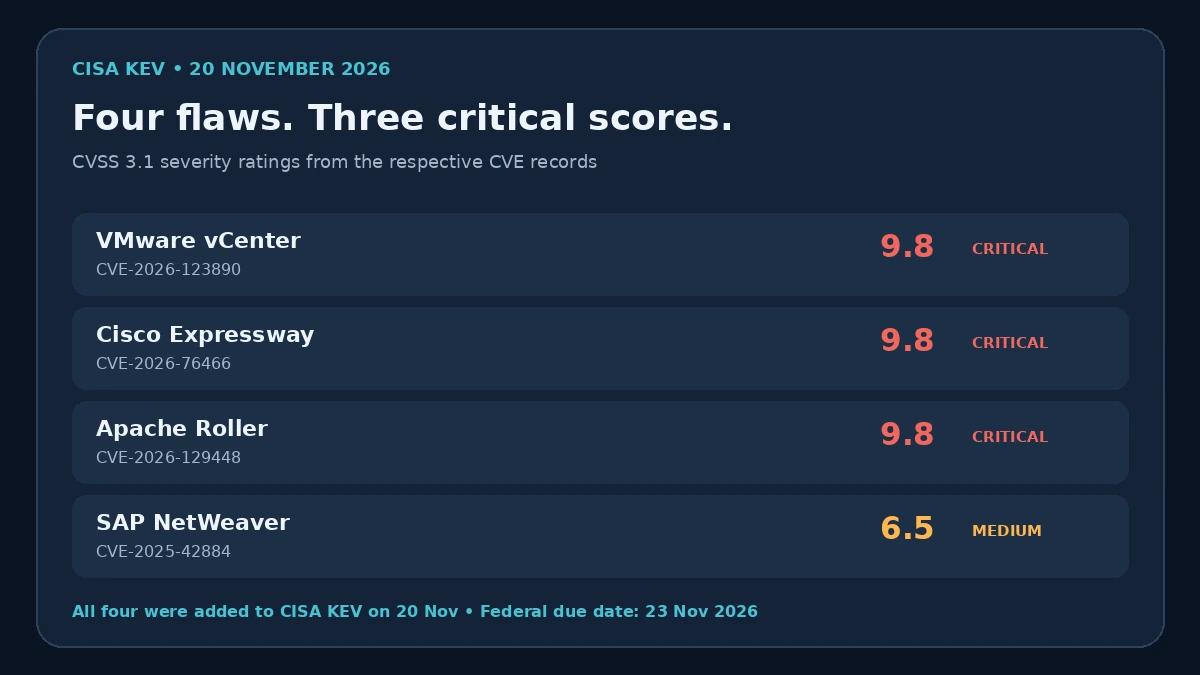
The supplied headline's implication that all four vulnerabilities score 9.8 is incorrect. Three carry a CVSS 3.1 score of 9.8; the SAP NetWeaver issue is rated 6.5, or Medium, by SAP.
| Product | CVE | Vulnerability | CVSS 3.1 |
|---|---|---|---|
| Broadcom VMware vCenter | CVE-2026-123890 | Authentication bypass | 9.8 Critical |
| Cisco Expressway Series | CVE-2026-76466 | Use of hard-coded credentials | 9.8 Critical |
| Apache Roller | CVE-2026-129448 | Deserialization of untrusted data | 9.8 Critical |
| SAP NetWeaver Enterprise Portal | CVE-2025-42884 | JNDI injection / improper neutralisation of special elements | 6.5 Medium |
All four were added to the KEV Catalog on November 20. A KEV listing means CISA has identified reliable evidence that a vulnerability has been exploited in the wild. It does not mean every listed flaw was used by the same group, in the same campaign, or against the same targets. CISA's catalog is an input to risk-based vulnerability management, not a ranking based solely on CVSS scores.
VMware flaw was exploited before public disclosure
Broadcom's November 19 advisory, VMSA-2026-0009, describes CVE-2026-123890 as an authentication-bypass vulnerability in VMware vCenter's Directory Service. An attacker with network access to a vulnerable vCenter server can bypass authentication and gain unauthorised access. Broadcom assigns the flaw a maximum CVSS 3.1 base score of 9.8 and says there is no workaround; customers should apply the fixed releases listed in its response matrix.
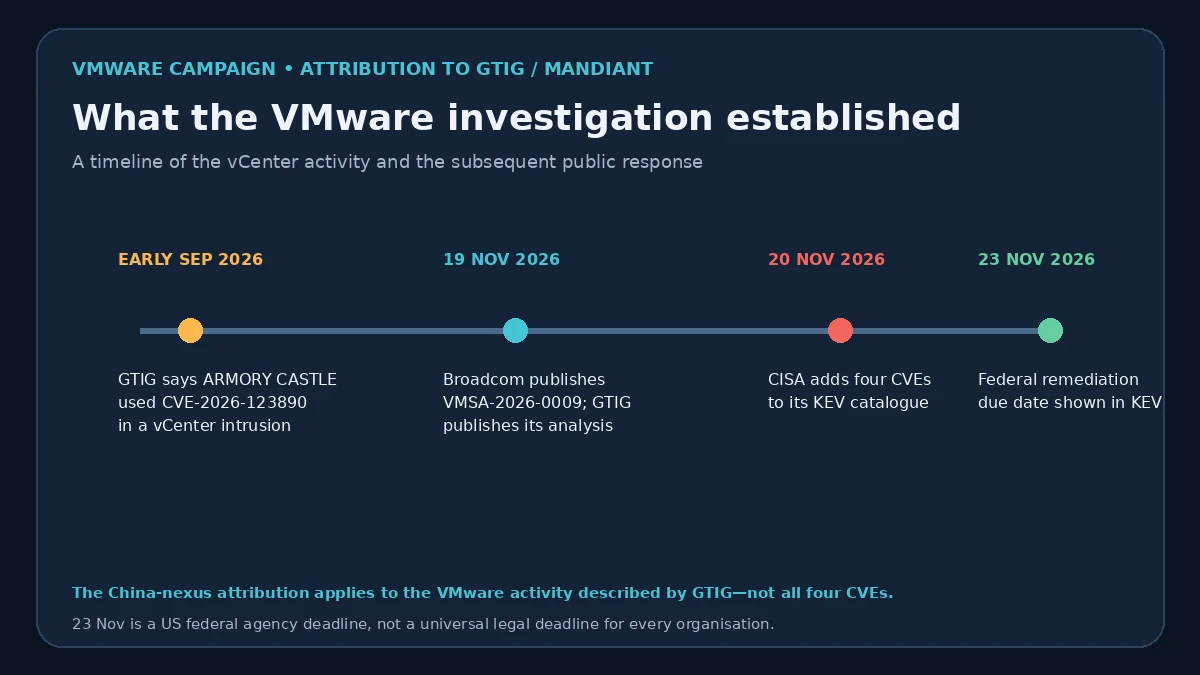
The timing is significant. In a November 19 investigation, GTIG and Mandiant said they had forensic evidence that ARMORY CASTLE exploited the flaw in early September 2026, more than two months before Broadcom publicly disclosed it. That makes the activity a zero-day exploitation campaign in the period before the vendor's November 19 disclosure.
GTIG attributes the activity to ARMORY CASTLE, a suspected People's Republic of China (PRC)-nexus espionage actor previously tracked as UNC5221. That attribution is the researchers' assessment; it should not be presented as a public government attribution or as proof that every one of the four newly listed vulnerabilities was used by the group.
The report describes a broader intrusion in which the actor moved from a compromised remote-support appliance into internal systems and then targeted vCenter. GTIG says the attackers used a custom utility it calls BONESAW to exploit the vCenter flaw, create an SSO administrator account, access the vCenter directory database and obtain material that could be used to hijack the VMware Security Token Service. The investigation also describes access to ESXi storage and virtual-machine files, alongside the deployment of several backdoors and other malware.
The significance is not limited to one server. vCenter is the management plane used to administer VMware environments. A successful compromise can therefore expose more than the management interface itself: it can give an intruder a route to the virtual machines and infrastructure managed through that control plane. GTIG's report documents this activity in the investigated environment; it does not establish that every vulnerable vCenter installation has been compromised.
The other three flaws have different exploitation records
Cisco Expressway: hard-coded credentials
CVE-2026-76466 affects the database service in Cisco Expressway Series. Cisco's October 21 advisory says an unauthenticated remote attacker with network access and possession of persistent cookies could execute operating-system commands as root on a clustered device. Cisco attributes the issue to hard-coded credentials and insufficient validation of client certificates under a particular clustering configuration.
Cisco lists X15.5.20 as the first fixed release for the X15.5 train; customers on X14 and earlier are directed to migrate to a fixed release. The advisory says there are no workarounds. At the time Cisco published it on October 21, its Product Security Incident Response Team said it was not aware of public announcements or malicious use. CISA added the CVE to KEV on November 20, a later development. The two statements refer to different dates and should not be collapsed into a claim that Cisco confirmed the exploitation.
CISA's listing establishes that the agency has evidence meeting its KEV criteria. The public material reviewed for this story does not attribute this Cisco activity to ARMORY CASTLE or to the VMware campaign.
Apache Roller: unauthenticated deserialization
CVE-2026-129448 affects Apache Roller versions 4.0.0 through 6.1.4. The XML-RPC endpoint accepts vendor extension types and deserialises them before authenticating the requester, potentially allowing an unauthenticated remote attacker to execute code.
An Apache Roller maintainer disclosed on the project's security mailing list on November 17 that the issue was being actively exploited. The notice recommends upgrading to Roller 6.1.6 or later. It also explains that the issue is related to CVE-2026-82384 but covers a broader affected-version range. The project's notice describes temporary configuration changes for installations that cannot immediately upgrade; administrators should follow the current Apache security notice rather than assume that disabling XML-RPC only through the administration interface is sufficient.
The Apache disclosure confirms exploitation of this Roller flaw, but the notice does not identify the attacker or connect the activity to the VMware espionage operation.
SAP NetWeaver Enterprise Portal: JNDI injection
CVE-2025-42884 affects SAP NetWeaver Enterprise Portal components EP-BASIS 7.50 and EP-RUNTIME 7.50. SAP's November 2025 security bulletin describes the issue as a JNDI injection vulnerability. An unauthenticated attacker can inject JNDI environment properties or supply a URL used in JNDI lookup operations, potentially allowing disclosure or modification of server information. The CVE record assigns a CVSS 3.1 score of 6.5 Medium; it records no availability impact.
SAP's security bulletin identifies Security Note 3660969 for the vulnerability. CISA's addition of the CVE to KEV on November 20 means it has evidence of exploitation, despite the flaw's Medium CVSS rating and its disclosure in 2025. The public sources reviewed do not establish who exploited it, when the exploitation began or whether it is connected to the VMware or Cisco activity.
What the November 23 deadline means
CISA's KEV records list November 23, 2026 as the remediation due date for all four entries. The deadline is tied to federal vulnerability-management requirements. Binding Operational Directive 26-04 applies to U.S. Federal Civilian Executive Branch agencies; it does not create a universal legal deadline for private companies, foreign governments or every organisation using the affected products.
BOD 26-04 directs agencies to prioritise remediation using factors including whether an asset is publicly exposed, whether the vulnerability is in KEV, whether exploitation can be automated and the technical impact after exploitation. Its response timelines can also require forensic triage in designated cases. CISA encourages other organisations to use the KEV Catalog when prioritising their own patching, but the directive's mandatory requirements apply to the agencies within its scope.
For defenders, the practical response is to identify whether any of the four products are deployed, check exact versions against the vendor's current advisory, and prioritise exposed or otherwise high-risk systems. Where a system may have been reachable during the relevant exploitation period, patching alone may not establish that it was never compromised. Review authentication and administrative-account changes, investigate unusual access to management interfaces and virtual-machine storage, and follow vendor and CISA forensic guidance. Do not assume the VMware-specific indicators or attribution apply to Cisco, Apache or SAP systems.
What administrators should do now
- VMware: Review Broadcom advisory VMSA-2026-0009 and apply the fixed release that matches the deployed vCenter version. Broadcom says there is no workaround for CVE-2026-123890.
- Cisco: Review Cisco advisory cisco-sa-vcs-static-cred-hr7EWZ8t. Upgrade to the first fixed release identified for the deployed Expressway train; Cisco says no workaround addresses the flaw.
- Apache Roller: Upgrade affected 4.0.0–6.1.4 installations to 6.1.6 or later, following the Apache security notice.
- SAP: Review SAP Security Note 3660969 for the affected NetWeaver Enterprise Portal components and the applicable correction for the installed system.
- All environments: Check the CISA KEV entries and BOD 26-04 requirements relevant to the organisation. Preserve logs and assess potential compromise where exposure or suspicious activity is identified.
The four KEV additions are a shared patch-prioritisation signal, not evidence of one coordinated campaign. The VMware case is the one with a detailed public account of a suspected China-nexus actor exploiting a zero-day to reach virtualisation infrastructure. Apache's maintainers separately disclosed active exploitation, while CISA's listings provide the public exploitation signal for Cisco and SAP. Keeping those evidence trails separate is essential to understanding what is known—and what remains unproven.
Sources and further reading
- CISA Known Exploited Vulnerabilities Catalog
- CISA Binding Operational Directive 26-04
- Broadcom: VMSA-2026-0009
- Google Threat Intelligence Group / Mandiant: ARMORY CASTLE Exploits vSphere
- Cisco Security Advisory: CVE-2026-76466
- Apache Roller security mailing-list notice: CVE-2026-129448
- SAP Security Patch Day Bulletins — 2025
AI-assisted content
This story was drafted and/or edited with AI assistance and reviewed before publishing.
Explore more topics
Related stories

OpenAI and Cisco Launch Shirudo, an Experimental Runtime Shield for Linux
OpenAI and Cisco have open-sourced Shirudo, a project designed to deploy temporary protections while teams prepare software patches. Its first public demonstration is narrow, and the project’s own documentation says it is not ready for production.