GAO: 17 of 22 Federal Agencies Fall Short on Zero Trust
A GAO report found 17 of 22 federal agencies fell short on zero-trust planning, highlighting gaps in US government cybersecurity readiness.

A new Government Accountability Office review found that only five of 22 major civilian federal agencies fully addressed selected federal guidance in their zero-trust implementation plans, leaving 17 with gaps in areas such as asset visibility, system maturity and project governance.
The report, GAO-27-108661, published on November 18, assessed agencies’ plans against selected guidance from the Office of Management and Budget (OMB) and the National Institute of Standards and Technology (NIST). The assessment reflects documentation available as of August 2026. It does not mean that 17 agencies have no zero-trust programme, nor does it establish that those agencies have suffered cyberattacks.
The five agencies whose plans addressed all the selected guidance were the Departments of Labor, Transportation and Veterans Affairs, the General Services Administration, and the Social Security Administration. GAO said almost all 22 agencies had developed zero-trust plans, and agencies were continuing implementation even where their documentation fell short.
What GAO actually measured
Zero-trust architecture is based on verifying access attempts rather than treating activity inside an organisation’s traditional network boundary as inherently trustworthy. NIST’s model requires organisations to understand the users, devices, applications and other entities seeking access, then make access decisions using policy and security information.
GAO did not conduct a penetration test of the 22 agencies or measure how many intrusions they had suffered. It compared implementation plans with seven selected elements drawn from OMB Memorandum M-24-14, NIST Special Publication 800-207 and NIST Special Publication 800-35.
The distinction matters. A plan that fails to document a process may indicate a real governance or visibility weakness, but it is not the same thing as proof that the process or security control does not exist. GAO’s report records agency explanations that work was underway but was not fully reflected in the submitted plan.

The gaps are concentrated in visibility and governance
The report’s seven measures show that performance varied by requirement rather than revealing one uniform failure across all agencies.
| Selected planning element | Fully addressed | Partially addressed | Not addressed |
|---|---|---|---|
| Cover zero trust across all information systems | 20 | 1 | 1 |
| Document maturity of all high-value assets and high-impact systems | 13 | 6 | 3 |
| Identify actors across the enterprise | 11 | 11 | 0 |
| Identify enterprise-owned assets | 19 | 3 | 0 |
| Plan expansion of zero-trust architecture | 18 | 3 | 1 |
| Document project-management roles and responsibilities | 13 | 4 | 5 |
| Document the implementation process | 19 | 2 | 1 |
Source: GAO-27-108661. Each row represents the 22 agencies assessed; figures are not a single overall maturity score.
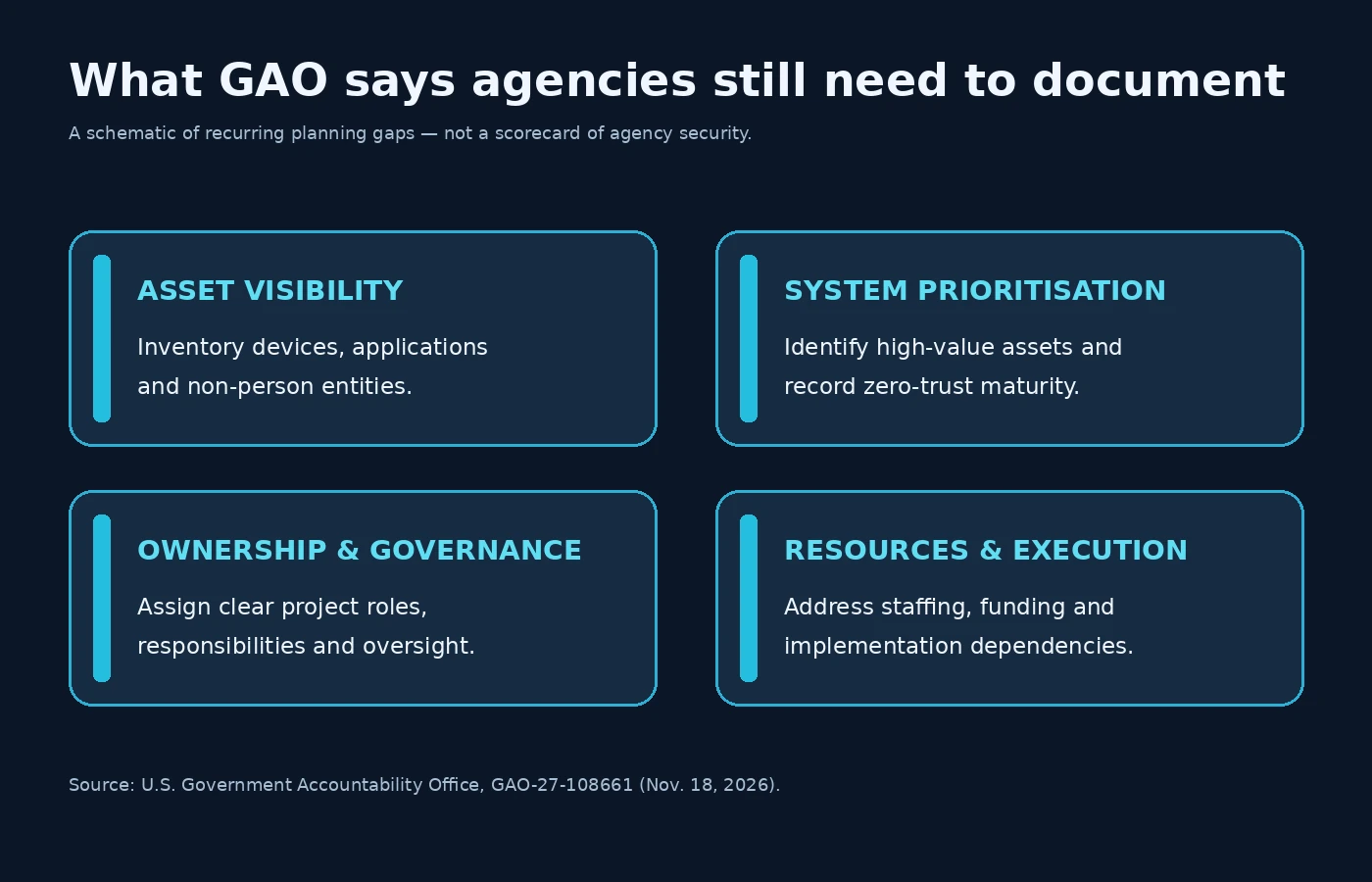
The weakest result was documenting project-management roles and responsibilities: five agencies had not addressed that element, and four only partially addressed it. Only 11 agencies fully documented procedures for identifying all enterprise actors; the other 11 had partial procedures.
That actor-visibility gap is especially important as enterprise systems rely on more than human users. NIST’s concept includes non-person entities such as service accounts and automated processes. GAO found that several agencies documented how they identified human users but did not document procedures for identifying non-person entities.
Asset inventory was stronger: 19 agencies fully addressed the selected guidance and three did so partially. But GAO noted that identifying devices involves more than maintaining a list; it also includes configuration management and monitoring.
Why agencies said their plans were incomplete
GAO’s interviews and the agencies’ written responses describe a mix of staffing, funding, organisational and documentation issues.
The Department of Commerce said staffing losses constrained its ability to sustain its zero-trust working group and produce comprehensive documentation. Interior officials cited funding and attrition issues and said the department lacked a dedicated zero-trust organisation. The Department of Justice said resource constraints prevented it from fully assessing and documenting maturity levels for all high-value assets and high-impact systems.
Other explanations were more specific. The Department of Education said its initial investment prioritised human-centred identity risks because those were considered high-impact threats that could be addressed with the limited modernisation funding available at the time. Treasury officials said non-person entities were not operating in the department’s environment when its initial plan was developed, and that they intended to include them in future plans.
The Department of Energy said it had a project underway to include non-person entities in its records, with the work expected to run through December 2028. That is a useful example of why the audit should not be read as a snapshot of whether an agency is doing any work at all: the report assesses what was documented at the review point, while some remediation was still in progress.
GAO also identified a structural problem at the Department of Health and Human Services. HHS told the auditors that its operating divisions had autonomy to plan and execute zero trust. But GAO said the department had not documented an enterprise-wide plan covering all its information systems, making it harder for management to maintain a coherent view of the overall transition.
Forty recommendations, with agency responses
GAO issued 40 recommendations to the 17 agencies whose plans did not fully address the selected guidance. Thirteen agencies agreed with the recommendations; four neither agreed nor disagreed. Several agencies described planned corrective actions in their responses included in the report.
The recommendations are specific rather than a single order to “adopt zero trust”. They include identifying actors and assets, documenting maturity levels for high-value assets and high-impact systems, setting out how the architecture will expand, and clarifying who is responsible for implementation.
The report’s recommendation status pages list the actions as open, with GAO saying it will update their status when it confirms what agencies have done. The recommendations therefore should not be described as completed remediation or as proof that agencies have ignored the audit.
Why the finding matters—and what it does not prove
Zero trust is not a single product that an agency can buy and declare finished. It is an evolving security architecture spanning identity, devices, networks, applications and workloads, and data. CISA’s maturity model describes progressive levels across those pillars, while NIST’s guidance emphasises understanding the enterprise before expanding the architecture.
Incomplete plans can make it harder for leaders to see which systems are covered, where maturity is weakest, who owns the work and where resources should go. GAO warned that this can leave agencies less able to establish and maintain zero-trust architectures, increasing the risk of cyberattacks that could interrupt operations or compromise government resources.
That warning is not a finding that the 17 agencies were breached. Nor does the report connect their planning gaps to the recent Microsoft, FAA, banking or NSA service disruptions. Those events have separate reported causes and should not be used as evidence of a link that GAO did not establish.
The audit also has a defined scope: 22 of the 23 civilian agencies covered by the Chief Financial Officers Act of 1990. It is not a review of every federal department or the Department of Defense. GAO’s assessment is based on plan documentation compared with selected OMB and NIST guidance, alongside interviews with agency officials.
The central finding is therefore about execution discipline and management visibility. Most of the agencies had plans and were implementing zero trust, but many had not fully documented the inventories, maturity assessments and responsibilities needed to manage that transition. GAO’s 40 recommendations now give those agencies a defined set of gaps to address.
Reporting cutoff: 2026-11-21, 08:20 UTC.
AI-assisted content
This story was drafted and/or edited with AI assistance and reviewed before publishing.
Explore more topics
Related stories

OpenAI and Cisco Launch Shirudo, an Experimental Runtime Shield for Linux
OpenAI and Cisco have open-sourced Shirudo, a project designed to deploy temporary protections while teams prepare software patches. Its first public demonstration is narrow, and the project’s own documentation says it is not ready for production.