Anthropic Brings Claude to Meetings for Notes and Actions
Claude Meetings beta joins Google Meet to capture notes, transcripts, and action items for Team and Enterprise users, with no audio stored.
Anthropic is extending Claude from a chat assistant into the meeting room. Its new Claude Meetings beta is designed to join a supported video call, follow the discussion and help create work products such as notes, documents, whiteboards and action items while the meeting is under way.
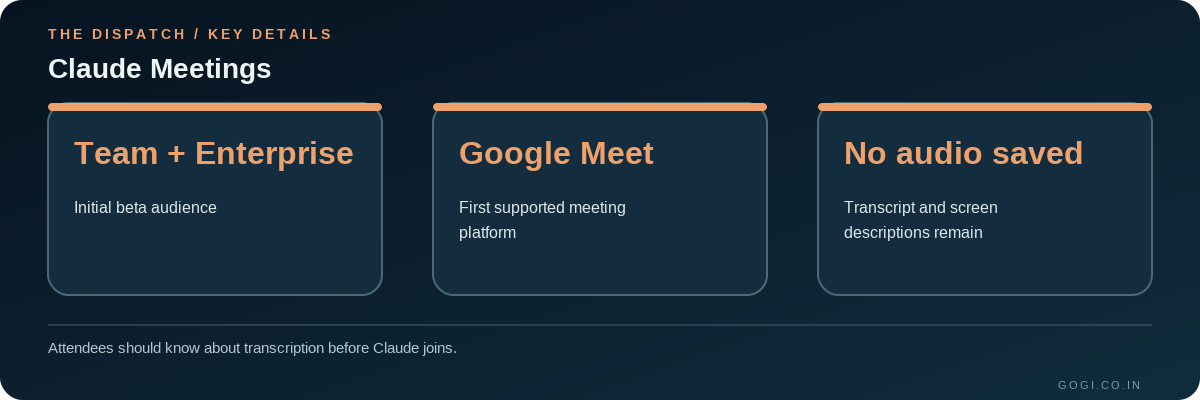
The launch targets workplace customers rather than the general Claude audience. Anthropic says the beta starts on Team and Enterprise plans, with Google Meet as the first supported conferencing service and other meeting platforms planned later.
The feature is part of a wider push to make assistants useful across an entire work process: not just answering questions after a meeting, but capturing the discussion and helping turn it into the work that follows.
From meeting conversation to work product
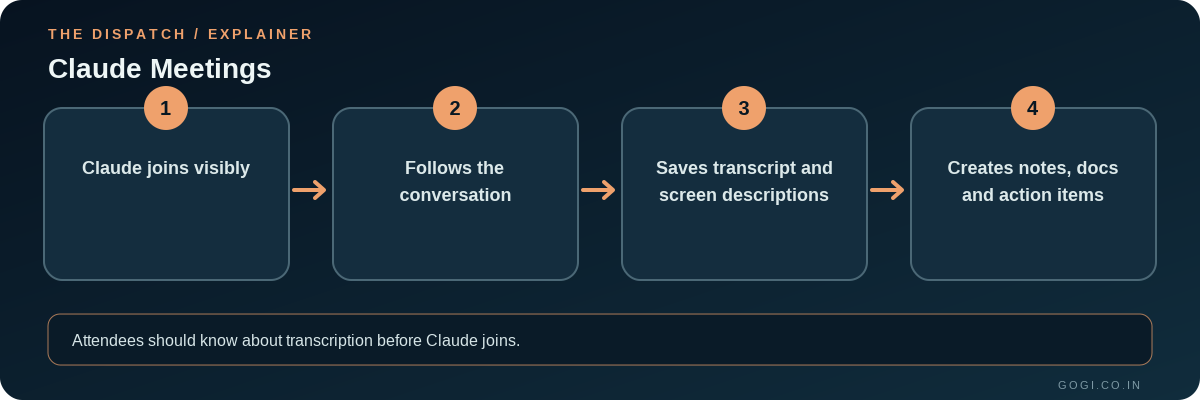
Anthropic says Claude can join as a visible participant, answer questions in the meeting, write notes and action items, and work with participants to create documents, whiteboards and other artefacts. The assistant can respond in writing by default and may use connected tools with permission.
Meeting assistants that create transcripts and summaries are not new. Claude’s more ambitious pitch is that the conversation can become material for ongoing work inside the same environment, rather than ending as a static meeting recap.
That does not remove the need for human review. Decisions that were never stated clearly, actions without an owner or unresolved disagreements can still be misrepresented by an automated summary. Teams should check generated notes before treating them as an authoritative record.
Google Meet first, with plan controls
Anthropic says Google Meet is the initial supported platform. Other conferencing services are planned, but the first beta is narrower than a universal meeting assistant.
On Team plans, Claude Meetings is available by default and an owner can turn it off. On Enterprise plans, an administrator must enable it for the organisation or selected groups. The feature is not currently available to some organisations, including those with zero-data-retention (ZDR), HIPAA-ready or customer-managed encryption-key (CMEK) configurations.
Anthropic says notes and transcripts are free during the beta for Team and Enterprise customers. Answers are also included unless Claude uses a connected tool, in which case the relevant usage may count against the plan.
It stores transcripts, not audio
Anthropic says Claude Meetings saves a transcript, summary and screen descriptions, but not the meeting audio itself. That distinction is useful, but it does not make the feature equivalent to a system that records nothing. A transcript can contain names, financial details, customer information, product plans and sensitive personal information.
The company tells users to make sure everyone on a call is comfortable with being transcribed before adding Claude or enabling auto-join. That is an important operational requirement: the person who invites the assistant is not the only person whose information may be captured.
The legal requirements can also vary by jurisdiction and workplace. An organisation’s internal permission to enable a feature does not automatically settle every participant-consent or employee-monitoring question.
A governance decision for employers
Teams should decide which calls can use an AI participant, tell attendees when Claude is present, and set rules for the resulting transcripts and artefacts. They should also determine who can access those records, how long they are retained and whether the content can be used in connected tools.
The stated exclusions for ZDR, HIPAA-ready and CMEK configurations are especially relevant to regulated customers. Organisations with those requirements should not assume the beta is suitable simply because Claude Meetings appears in their plan.
A step towards workflow agents
Claude Meetings reflects a broader product direction: assistants are being connected to the software and processes where work actually happens. Capturing a discussion is only the beginning; the value proposition is reducing the distance between a decision and its follow-through.
The beta will need to prove that it can reliably distinguish decisions from suggestions, preserve nuance and create useful tasks without inventing commitments. It will also need to show that organisations can govern transcripts and access in ways that match their policies.
For now, the announcement is best understood as an early workplace beta with a defined plan, platform and data-retention scope—not as a general-purpose recorder available to every Claude user.
Sources
- Anthropic: Claude Meetings — primary source for features, beta scope, plan eligibility, transcript handling and limitations.
- Claude’s official X launch post — confirms the beta and workplace workflow.
- Claude’s official X follow-up on Google Meet — identifies Google Meet as the initial conferencing platform.
- Reuters: Anthropic brings Claude to Google Meet to tackle tasks live (10 November 2026) — independent launch coverage. Reuters reported the introduction on 10 November; Anthropic's dedicated product page is dated 12 November.
- TechCrunch: Anthropic launches Claude Meetings to turn workplace discussions into plans and tasks (10 November 2026) — independent coverage of the beta and meeting workflows.
- Anthropic Help Center: Use Claude Meetings — operational details and the instruction to secure participant agreement before transcription.
AI-assisted content
This story was drafted and/or edited with AI assistance and reviewed before publishing.