OpenAI Adds ChatGPT Wallet for Agentic Payments
OpenAI’s ChatGPT Wallet uses payment tokens for agent purchases, with biometric approval in the standard flow and terms allowing advance authorization.
OpenAI has introduced ChatGPT Wallet, a payment feature designed to let its agents complete purchases on a user’s behalf. The launch moves ChatGPT closer to handling transactions as part of a shopping workflow, but it does not give an agent access to a user’s actual card details.
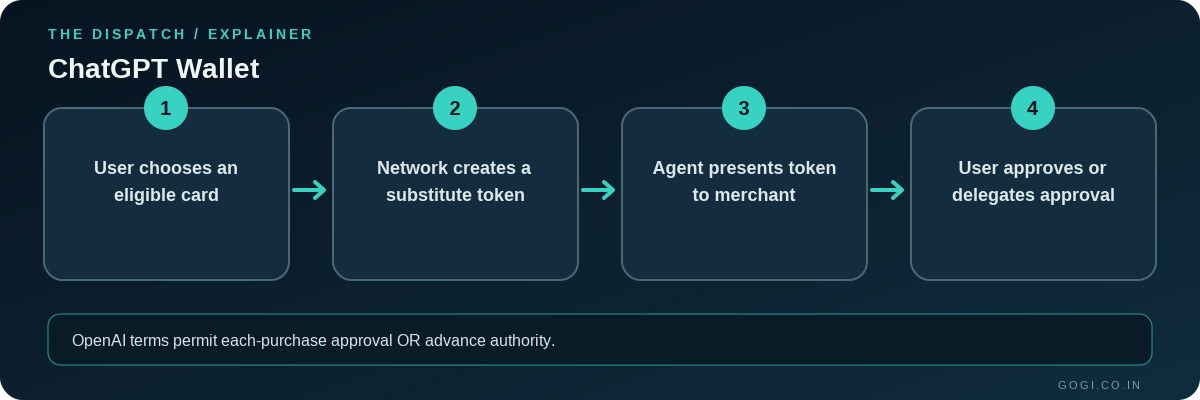
The company says Wallet uses a substitute payment credential created by the payment network. In the standard checkout flow described by OpenAI, the user reviews the merchant, items, total and selected card, then approves the purchase with a security check such as Face ID or Touch ID.
There is an important nuance in the terms: users must review and approve each purchase or grant ChatGPT authority to approve purchases in advance. The second option means the product should not be described as requiring a fresh biometric approval every time in every possible configuration. The user’s advance authorisation is the control that makes that delegation possible.
How the payment credential works
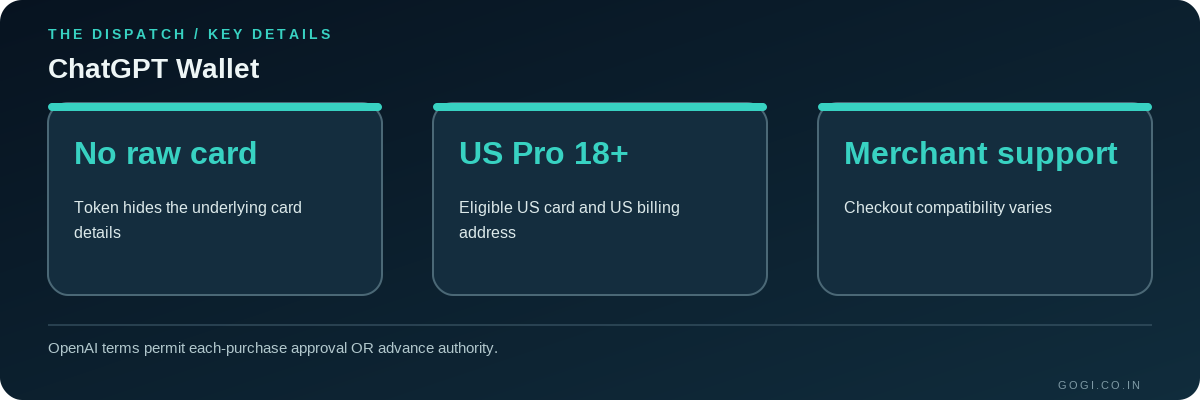
A user adds an eligible card to ChatGPT Wallet. When an agent is ready to make a purchase, the payment network provides a payment token—a substitute credential for the underlying card. OpenAI says the token keeps the actual card details hidden from the agent and the business receiving payment.
The wallet does not create a bank account or stored balance, extend credit or transfer money between users. It directs a payment credential linked to an eligible card to a merchant, while the user keeps the existing card relationship, rewards and protections for qualifying disputes.
A limited initial rollout
ChatGPT Wallet began rolling out in dots to ChatGPT Pro subscribers aged 18 or older in the United States, with an eligible US-issued card and a US billing address. OpenAI says the rollout is limited while it works with businesses, banks and payment networks to improve compatibility.
Not every website is ready to accept agent-made purchases. OpenAI says merchants may need to make sure their sites and risk systems recognise legitimate requests from agents. It also warns that a successful authorisation does not itself confirm an order; users should check the merchant’s confirmation after checkout.
The approval model has two paths
OpenAI’s launch description presents a user-led checkout: before the purchase, the person sees the merchant, items, total and card, then approves with a biometric security check. This makes the assistant a purchase agent, not a holder of the card credentials.
The Wallet terms, effective 12 November 2026, also allow the user to grant ChatGPT authority to approve purchases in advance. That is a form of delegated authority, not unrestricted autonomy: the user must grant it. OpenAI’s announcement says the company expects more detailed delegation controls—such as spending limits, purchase categories and time windows—to develop over time.
The difference matters for consumer protection. A one-time biometric approval is easy to understand; advance authorisation raises additional questions about scope, duration, merchant eligibility, transaction limits, recurring charges and how a user revokes the permission. OpenAI’s public materials describe the direction of travel, but do not yet settle every operational detail of how those controls will work across all merchant flows.
What users should check
A payment token that hides the card number from an agent is a meaningful security boundary, but it is not the whole payment-safety problem. Users still need to know what is being bought, the total amount, shipping, recurring charges, refund terms and the merchant receiving payment.
For any purchase flow, users should inspect the details that appear before authorisation and confirm the resulting order with the merchant. If they choose advance delegation, the scope of that authority becomes just as important as the card credential itself.
A step towards agentic commerce
The wallet is a meaningful product step because it connects product discovery and checkout inside one assistant-driven process. It also shows how AI companies are trying to turn agents from tools that recommend actions into systems that can carry out real-world tasks.
But the key question is no longer simply whether the model can see a card number. It is how clearly users can define, understand and revoke the authority they give an agent to spend. ChatGPT Wallet creates the payment infrastructure for that experiment; its broader adoption will depend on whether its controls remain transparent as more purchases are delegated.
Sources
- OpenAI: Introducing ChatGPT Wallet, 13 November 2026 — primary source for the feature, tokenised payment flow, rollout and approval experience.
- OpenAI: ChatGPT Wallet terms, effective 12 November 2026 — says the user must approve each purchase or grant ChatGPT authority to approve purchases in advance.
- ChatGPT’s official X announcement — official post describing agent-assisted purchases.
- Reuters: OpenAI launches ChatGPT Wallet, letting AI agents pay for purchases (13 November 2026) — independent reporting on the launch, payment-network partners and initial US rollout.
- OpenAI: ChatGPT Wallet privacy notice — primary source for wallet-related data handling.
AI-assisted content
This story was drafted and/or edited with AI assistance and reviewed before publishing.
Explore more topics
Related stories

OpenAI and Cisco Launch Shirudo, an Experimental Runtime Shield for Linux
OpenAI and Cisco have open-sourced Shirudo, a project designed to deploy temporary protections while teams prepare software patches. Its first public demonstration is narrow, and the project’s own documentation says it is not ready for production.