Mathematician Claims Claude Helped Prove Riemann Hypothesis
Levent Alpöge says he and Claude found a Riemann hypothesis proof. The Lean files are public, but independent verification remains incomplete.
Reporting cutoff: 2026-11-20, 18:30 UTC
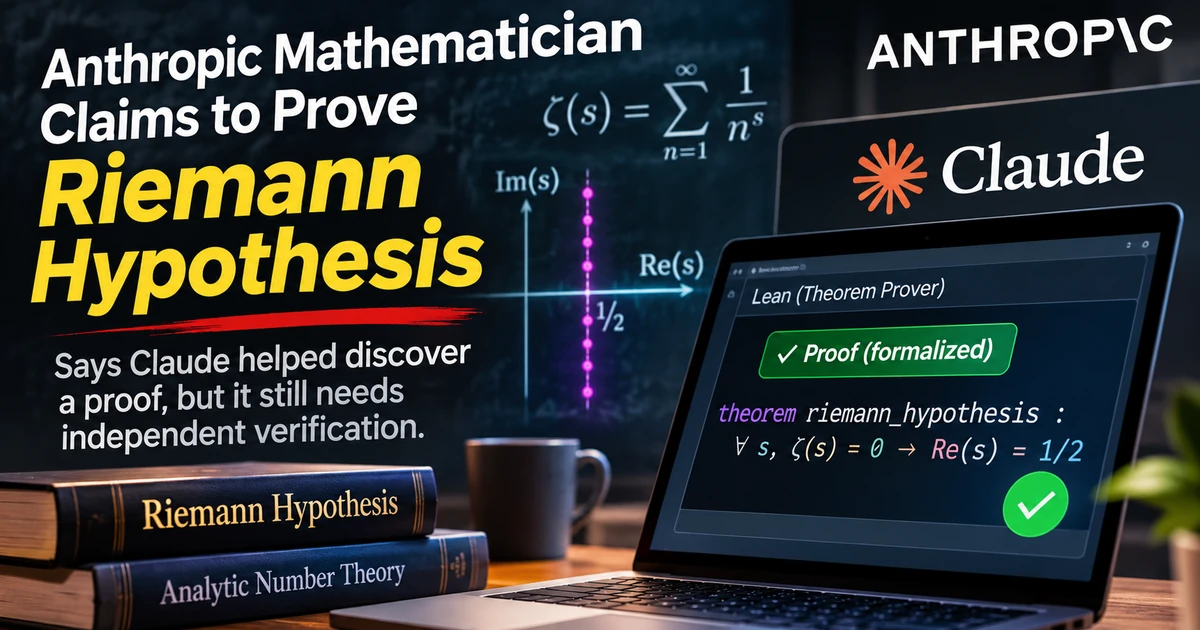
Levent Alpöge, a mathematician employed by Anthropic, says he and the company's Claude AI model have found a proof of the Riemann hypothesis, one of mathematics' most important unsolved problems. He has published a short statement and a large Lean formalisation of the argument. The central claim has not been independently established: machine-checkable files are not, by themselves, a completed mathematical review.
In a four-page note dated November 20 on his personal website, Alpöge writes that he believes he has discovered a proof with Claude. He says the method also resolves the Generalized Riemann Hypothesis (GRH), and that he expects it may extend to the Extended Riemann Hypothesis. These are the author's claims, not conclusions endorsed by Anthropic, the Clay Mathematics Institute or the wider mathematical community.
Alpöge describes guiding the work toward an approach inspired by a simplified mathematical setting. Claude then supplied key technical ideas, including a proposed length for a chain of theta lifts. Alpöge says the model outpaced him near the end. He also acknowledges that he does not yet fully understand some of the argument's technical details and intends to produce a more accessible account.
What the Riemann hypothesis says
The Riemann hypothesis dates to Bernhard Riemann's 1859 work on prime numbers. It concerns the non-trivial zeros of the Riemann zeta function, a mathematical object deeply connected to how prime numbers are distributed.
In simplified terms, the conjecture says every non-trivial zero of the zeta function has a real part equal to one-half. The Clay Mathematics Institute describes the problem as a statement about how far the distribution of primes deviates from its average pattern. A large number of zeros have been checked computationally, but checking examples cannot replace a proof covering every case.
The Riemann hypothesis is one of the seven Millennium Prize Problems, each carrying a potential US$1 million award under the Clay Institute's rules.
A Lean formalisation still needs scrutiny
Alpöge says the argument has been formalised in Lean without additional assumptions. Lean is a proof assistant: mathematical statements and deductions are encoded in a formal language, and its kernel checks whether a proof term follows from the rules and definitions in the environment.
Formalisation can make an argument mechanically checkable. It does not remove the need to establish that the formal theorem is exactly the standard Riemann hypothesis being claimed, that the proof compiles and checks in the stated environment, and that no inappropriate assumptions or gaps enter through dependencies or definitions.
An independent review record published by State of Proof on November 20 identifies the correspondence between the Lean statements and the standard hypotheses, together with the dependency tree and imported assumptions, as key checks still requiring examination. Its intake record says its examination of the full archive had not begun. A separate technical account reported preliminary build and statement checks, but said the more demanding proof replay and assumptions audit were still incomplete. Those preliminary checks are not independent confirmation of the theorem.
A public GitHub mirror of Alpöge's Lean archive describes itself as an unmodified mirror and says no independent build or review had been published at the time of mirroring. A mirror makes source easier to inspect; it does not validate the mathematics.
The author has not yet published a readable paper
Alpöge's note describes the formalisation as finished but says the argument is extremely long and difficult to read in its current form. He intends to understand it more fully, explain its simplifications and write it up properly.
There are two related tasks. One is formal verification: checking declarations, dependencies and proof terms in Lean. The other is mathematical exposition and expert scrutiny: understanding why the argument works and whether it proves precisely the intended statements. A formal proof can assist that process, but mathematicians still need to examine what has been formalised.
The distinction matters for claims about AI. Alpöge attributes important steps to Claude, but the available evidence is his account of the collaboration. The note is not a controlled evaluation of Claude's mathematical capability and does not establish how much of the result would have been possible without the model.
Anthropic described a separate Claude effort on the Riemann hypothesis in August 2026. The company said that attempt did not solve the conjecture, although it improved a lower bound on the proportion of zeros known to lie on the critical line from 41.6 per cent to 67.2 per cent. That earlier result is context, not independent support for Alpöge's new claim.
What would count as confirmation?
The next meaningful milestone is a reproducible, independent examination of the Lean project: identify the declarations for the classical Riemann hypothesis and GRH; compare their definitions and quantifiers with the standard statements; inspect the dependency tree and axioms; and replay the relevant proof terms in a clean environment.
Even a successful build would answer only part of the question. It would show that the submitted code is accepted by the specified Lean environment. Reviewers would still need to verify that the theorem proved is the theorem claimed and that the environment's assumptions are appropriate.
The Clay Mathematics Institute's prize rules set a separate institutional threshold. A proposed solution must be published in a qualifying outlet, at least two years must pass after publication, and the solution must receive general acceptance in the global mathematics community before the Institute will consider it for the prize. The Institute's problem page continues to list the Riemann hypothesis as unsolved.
For now, the defensible description is precise: an Anthropic mathematician says he and Claude have found a proof and has released a Lean formalisation. The files give mathematicians something concrete to examine. Until independent reviewers establish that the formalised argument proves the standard conjecture, the Riemann hypothesis should not be reported as solved.
The Dispatch has not compiled or replayed the Lean archive and has not independently checked the proof terms.
AI-assisted content
This story was drafted and/or edited with AI assistance and reviewed before publishing.