KPMG Canada Confirms Breach of Some Client Tax Documents
KPMG Canada confirmed unauthorized access to some client tax documents but has not disclosed the scale, timing, or method of the incident.
Reporting cutoff: 2026-11-21, 01:09 UTC
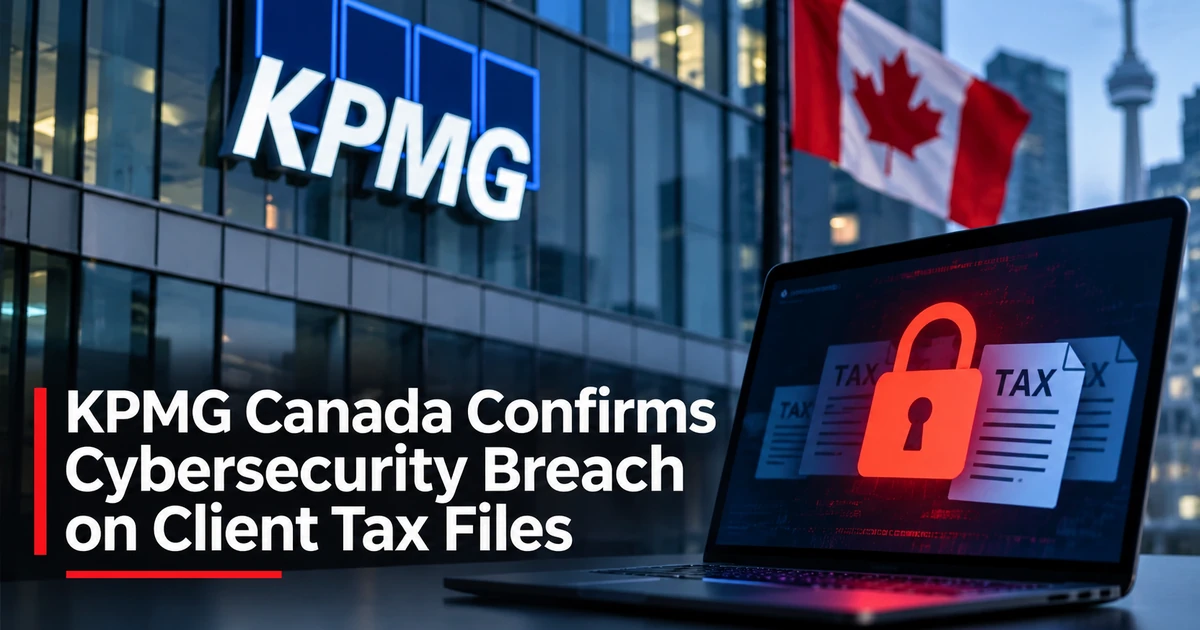
KPMG Canada has confirmed that an unauthorized third party accessed some clients’ tax documents, but the accounting firm has not disclosed how many clients were affected, how many files were accessed or how the intruder gained entry.
The firm says it contained the incident, secured its systems and is contacting affected clients. Its public account leaves important questions unanswered: when the access occurred, what categories of information were involved, whether copies were removed from KPMG systems and what investigation supports the firm’s assessment of the data’s current status.
The incident was first reported by The Globe and Mail on November 18, according to Reuters and subsequent coverage. Reuters, Bloomberg Law and The Canadian Press reported KPMG’s confirmation. Reuters said the firm had not disclosed the number of affected clients or files, or explained how the breach occurred. (Reuters; Bloomberg Law; The Canadian Press via Global News)
What KPMG has said
KPMG’s statement, as quoted by Reuters and Bloomberg, says the firm acted immediately to contain the incident and secure its systems. The company is contacting clients whose information was affected.
KPMG Canada spokesperson Sonja Cloutier-Bosworth said the firm was confident it had protected clients’ information. She added that, based on the firm’s ongoing monitoring, the information affected by the incident was not available online or being misused.
That is the firm’s assessment, not an independently established finding. The public reports do not describe the monitoring methods, period covered or whether external threat-intelligence services were used. They also do not establish whether the unauthorized access involved viewing documents inside a system, copying them elsewhere, or both.
Unauthorized access confirms that information was reached by someone without permission; it does not, by itself, establish the extent of exfiltration, public disclosure or subsequent misuse. Conversely, the absence of material being found online would not alone prove that no copies were taken.
The attack method has not been disclosed
The incident comes as Canadian organisations face a documented campaign involving help-desk impersonation and voice phishing, or “vishing”. In an October 28 alert, the Canadian Centre for Cyber Security said multiple Canadian firms had been targeted by people posing as internal IT support and directing employees to fraudulent sign-in pages. The alert identified legal and financial organisations among the sectors targeted.
The Cyber Centre described a technique in which an attacker impersonates a help desk worker, persuades an employee to complete an urgent password or multi-factor authentication change, and directs the employee to an organisation-branded sign-in page. Such a page can relay credentials and authentication responses to the legitimate identity provider, potentially giving the attacker an authenticated session. The agency also described post-compromise activity involving access to Microsoft 365 and connected services.
The advisory provides context for the wider threat environment. It does not identify KPMG as a victim of that campaign, and KPMG has not publicly attributed this incident to vishing, a compromised account, a software vulnerability, ransomware or any other specific method. Treating the advisory as an explanation for the KPMG incident would go beyond the evidence. (Canadian Centre for Cyber Security, Alert AL26-028)
Why the unanswered questions matter
Tax documents can contain sensitive personal and financial information. Depending on the documents involved, that can include identity details, income information, business records and other material that could be useful in fraud or targeted social engineering. The public account does not specify which of these categories, if any, were involved in the KPMG incident.
Affected clients should seek a clear account of what information related to them was involved. They can ask what dates and systems were in scope, whether files were copied, and what protective steps the firm recommends. They should use contact details they already trust or independently verified KPMG channels, and be wary of unsolicited calls or messages claiming to offer breach assistance or requesting passwords, authentication codes or payment.
For organisations that handle confidential client records, the Cyber Centre recommends phishing-resistant multi-factor authentication, stronger verification for account recovery and MFA changes, monitoring for suspicious authentication registrations and file-access activity, and preserving identity-provider and cloud-service audit logs. These are general defensive recommendations from the agency, not a description of controls KPMG has or has not implemented.
What remains unknown
As of the reporting cutoff, the public information reviewed for this article does not establish:
- The date or duration of the unauthorized access.
- The number of affected clients or documents.
- The types of tax or financial information involved.
- Whether information was copied out of KPMG systems, retained by an attacker or shared with another party.
- The initial access method, identity of the threat actor or motive.
- Whether a regulator or law-enforcement agency is investigating.
- The scope and methodology behind KPMG’s statement that the information is not available online or being misused.
KPMG’s confirmation makes the unauthorized access itself newsworthy. But the scale, technical cause and downstream consequences remain unresolved. Until the firm or an independent investigation provides more detail, the incident should be described as unauthorized access to some client tax documents—not as a confirmed public leak, ransomware attack or vishing compromise.
This report will be updated if KPMG or relevant Canadian authorities publish further verifiable information..
AI-assisted content
This story was drafted and/or edited with AI assistance and reviewed before publishing.