Moth Quantum Encodes 1,568 Values on IBM Quantum Chip
Moth Quantum’s Tessa method encoded 1,568 classical values on a 120-qubit IBM system, with a clear accuracy trade-off.
Moth Quantum has reported a hardware demonstration of Tessa, a method for encoding and recovering classical data across an entire quantum processor. The accompanying paper describes experiments on IBM Quantum hardware with up to 120 qubits and reports a maximum of 1,568 real values.
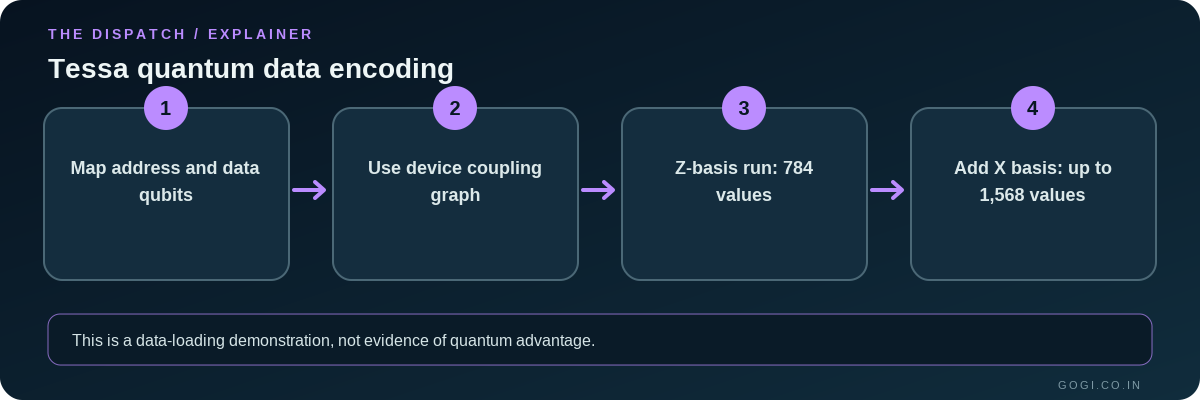
The headline number is notable, but it needs context. The 1,568-value result uses two measurement bases and has substantially lower correlation with the input data than the paper’s 784-value single-basis experiment. The work demonstrates a data-encoding method on quantum hardware; it does not demonstrate a quantum advantage for machine learning or another practical application.
How Tessa uses the processor
Tessa is short for Tessellated QPIXL. The method arranges address and data qubits across the device’s coupling graph so that neighbouring data qubits can share parts of the address register.
The paper describes a checkerboard arrangement in which each data qubit is controlled by adjacent address qubits. By using the processor’s physical connectivity, the construction can avoid SWAP gates and routing operations for the tested layout. The method also avoids adding separate ancilla qubits for the demonstrated construction.
This hardware-aware design is the central idea. Rather than treating the processor as a fully connected abstract register and paying the cost of routing interactions between distant qubits, Tessa maps its encoding pattern to the connections the device already provides.
Why the result is 1,568 values
The paper reports two different operating points on IBM’s 120-qubit Phoenix system.
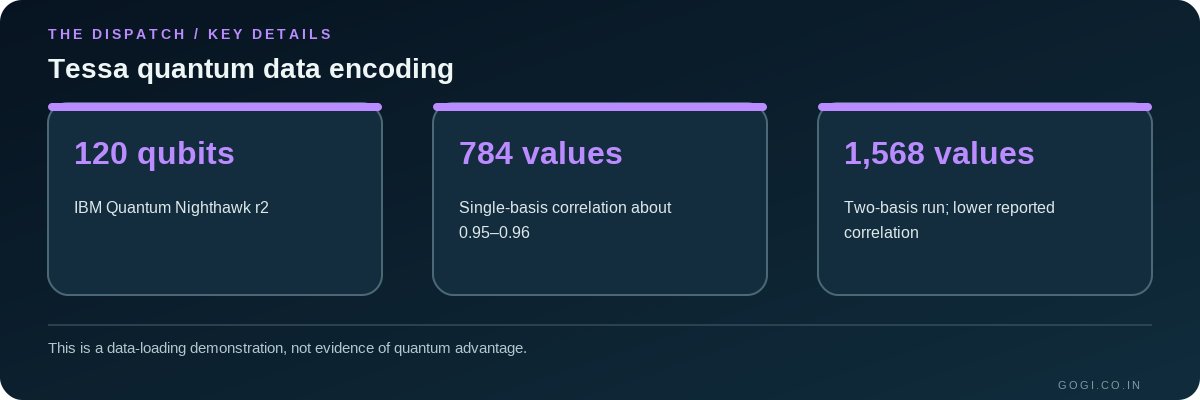
In the single-basis experiment, Tessa encoded 784 values using the Z basis. The reported hardware correlation between the recovered values and the input was 0.96. The experiment used 728 two-qubit controlled-Z gates and had a two-qubit gate depth of 23 after transpilation.
The 1,568-value result uses a pair of bases, Z and X, to encode a second value per slot. That increases capacity, but it also increases circuit cost and reduces the accuracy of the recovered data. The paper reports 1,456 two-qubit CZ gates and a two-qubit gate depth of 43 for the 1,568-value Phoenix run.
The measured correlation for the values in that pair-encoding experiment was 0.69, compared with 0.95–0.96 in the single-basis experiments. The table also reports a value mean absolute error of 0.152 and a hue error of 0.092 for the Phoenix pair run.
Those figures make the trade-off clear: doubling the nominal number of encoded values did not preserve the same quality of reconstruction.
What the experiment does—and does not—show
The authors demonstrate that Tessa can encode and decode arbitrary real-valued data on actual quantum hardware. Their examples include pixel images, audio, MIDI and biological sequences. The paper reports 8,192 shots per basis for the hardware experiments.
That is different from demonstrating that a quantum computer can perform a useful task on those datasets better than a classical system. Loading data is one part of a quantum-computing workflow, and it is itself a known bottleneck. The paper is about making that step more hardware-efficient; it does not claim that the encoded cat images, audio or sequence data produced a computational advantage.
There are also practical limitations. Readout requires repeated measurements, circuit quality affects recovered values, and the larger pair-encoding circuit shows a visible accuracy penalty. Results from a small number of demonstrations should not be treated as evidence that the method will scale without loss to other processors, noise profiles or workloads.
Why the result matters
The useful contribution is the way Tessa maps data encoding to a device’s connectivity graph. If that approach can be adapted to other processor layouts, it could help researchers use more of a chip for loading classical data without adding routing overhead.
But capacity alone is not enough. Researchers and potential users need to weigh how many values can be encoded against how accurately they can be recovered, how many measurements and gates are required, and whether the data-loading stage helps the computation that follows.
Moth Quantum’s 1,568-value demonstration is a meaningful hardware result. The paper’s own measurements show why it should be read as a capacity milestone with a fidelity trade-off—not as a general breakthrough in quantum AI.
Sources
- Moth Quantum: Tessa — loading data onto real quantum chips — company explanation of the hardware demonstration.
- Daniel Bultrini: Tessa: Encoding Classical Data Across an Entire Quantum Processor, arXiv:2611.18440 — original paper and experimental tables for qubit counts, gates, correlations and errors.
- IBM Quantum: Nighthawk r2 — IBM’s hardware documentation and processor context.
AI-assisted content
This story was drafted and/or edited with AI assistance and reviewed before publishing.
Explore more topics
Related stories

OpenAI and Cisco Launch Shirudo, an Experimental Runtime Shield for Linux
OpenAI and Cisco have open-sourced Shirudo, a project designed to deploy temporary protections while teams prepare software patches. Its first public demonstration is narrow, and the project’s own documentation says it is not ready for production.

Multi-Tenant Architecture in SaaS: Isolation Models, Security and Scaling
A practical guide to multi-tenant architecture in SaaS: compare silo, bridge and pooled models, design tenant-aware identity and data access, and prevent cross-tenant leaks across databases, APIs, caches, storage and background jobs.