Trump Confirms Firing of US Cyber Director Amid Tech Outages
Trump confirmed firing Sean Cairncross as US cyber director during a week of major tech outages, naming a successor as agencies responded.

Updated: 2026-11-21, 02:19 UTC — Added the FAA's stated router mitigation steps and clarified that its root-cause investigation remains open.
President Donald Trump confirmed on November 20 that he had fired Sean Cairncross as the White House’s National Cyber Director, a leadership change announced as a series of technical disruptions affected Microsoft services, US air traffic control, bank transactions and an internal National Security Agency network.
Asked why he had dismissed Cairncross, Trump told reporters: “Because I didn’t think that person was good enough.” The White House separately announced that Trump had named Pentagon Chief Information Officer Kirsten A. Davies to lead the Office of the National Cyber Director (ONCD).
The timing places the personnel change alongside a week of high-profile outages. It does not establish that the outages caused Cairncross’s dismissal. Trump and other administration officials have said the incidents were separate and that they found no evidence of a coordinated cyberattack. Public incident records reviewed so far describe different technical problems at the affected organisations.
A week of failures, not one documented outage
The incidents occurred within days of one another, but they should not be treated as a single event.
Microsoft’s disruption began on November 12 and affected Exchange Online and other Microsoft 365 services. On November 13, the Federal Aviation Administration (FAA) imposed a nationwide ground stop after instability in its telecommunications network affected aircraft communications and radar feeds. JPMorgan Chase reported transaction-processing delays on November 16. The NSA disclosed a temporary degradation of its internal classified communications network on November 17.
On November 18, Director of National Intelligence Jay Clayton and Secretary of State Marco Rubio told Congress and the public that officials had found no indication that the outages were connected or caused by a coordinated cyber operation. The White House published their statements, including Rubio’s assessment that the Microsoft incident had nothing to do with the FAA disruption and that the FAA issue was unrelated to the bank problems.
That is the administration’s assessment, not an independent forensic audit of every affected organisation. The available technical records nevertheless point to distinct failure mechanisms rather than one demonstrated common cause.
Microsoft: a latent defect, a failover and reduced capacity
The Microsoft 365 outage affected Exchange Online most severely, leaving many users unable to access mailboxes through Outlook and other clients while email delivery was delayed. Microsoft’s preliminary post-incident report identifies two incident records: EX1550543 for Exchange Online and MO1550821 for the wider Microsoft 365 service impact.
The preliminary report, dated November 15, gives an incident window from 4:20 p.m. UTC on November 12 to 4:10 p.m. UTC on November 13. That is a report-defined interval of 23 hours and 50 minutes, not a claim that every Microsoft product or customer experienced identical disruption for that entire period. Separate service-health records show the Exchange notice and the broader Microsoft 365 advisory being opened at different times.
Microsoft’s preliminary explanation is more specific than a general reference to routine upgrades. It says a latent defect in a connection-handling process on Microsoft 365 network-gateway servers had been deployed months earlier. A failover that moved Teams traffic onto the gateway also used by Exchange Online increased load, while nearly 14% of gateway capacity was already unavailable because of a separate issue. The combination exposed the defect. Automatic traffic redirection then spread the load across fewer remaining servers; Microsoft said more than 80% of the affected gateway servers became unresponsive at the worst point.
The report is explicitly preliminary. Microsoft said a final report would provide further detail, but a superseding final public version was not located by this story’s reporting cutoff. Third-party service-health archives list the incidents as resolved and record that a post-incident report was published on November 16; the report text available for review remains labelled preliminary. The document is a mirrored copy of Microsoft’s report, not a direct download from the Microsoft 365 admin centre.
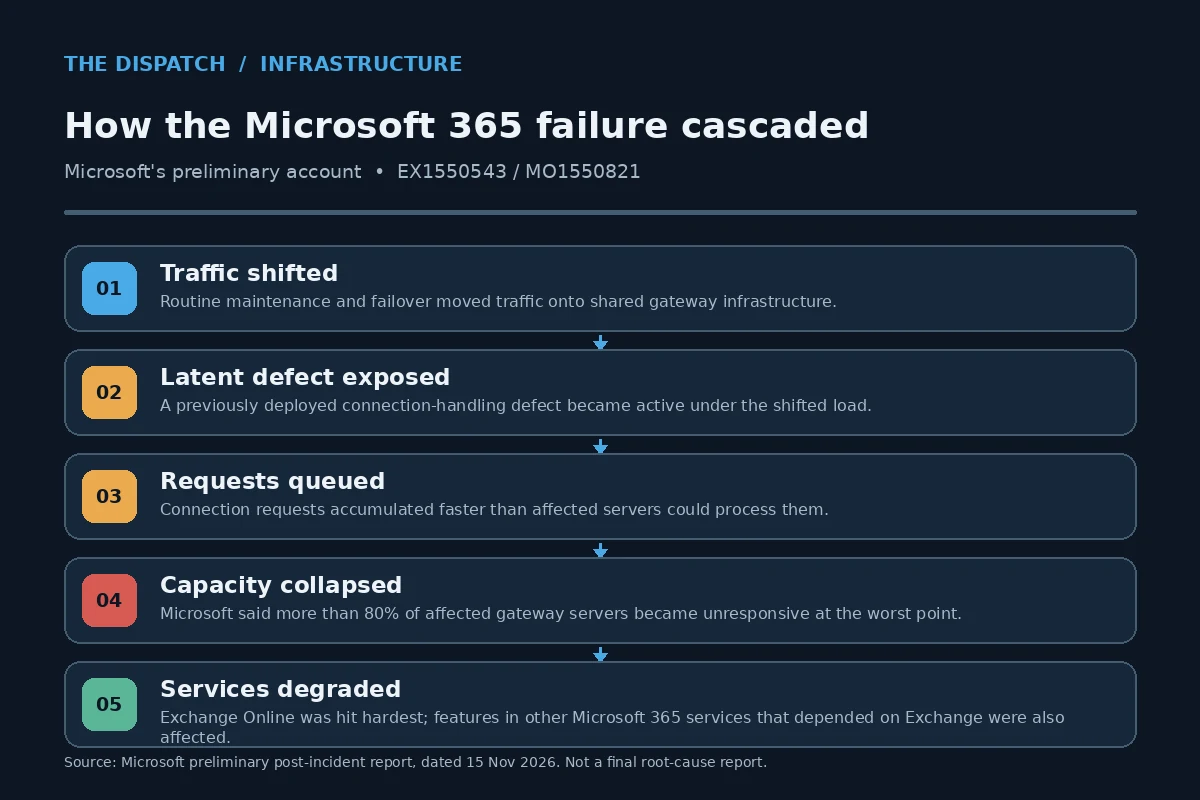
Diagram based on Microsoft’s preliminary post-incident report for EX1550543 and MO1550821; it is not a final root-cause finding.
FAA: legacy equipment and a router-related investigation
The FAA says the November 13 disruption began at about 3:30 p.m. Eastern Time, when legacy equipment became unstable as data flooded its FAA telecommunications network, according to its November 15 Q&A. The agency reported approximately 1,000 connection attempts every four to five seconds, disrupting the stability of aircraft communications and radar feeds.
The FAA said instability began at 17 of its 22 Air Route Traffic Control Centers and spread to several terminal radar facilities. Its initial investigation identified two possible sources of the excessive traffic: a radar site in Amarillo, Texas, and a radio communications site in El Dorado, Arkansas. The agency said its network provider, L3Harris, had been replacing equipment at the El Dorado site, including deploying a new router. The FAA’s Q&A says the broadcasting function was disabled on all new routers as a precaution. In a later answer, the agency said it believed it had addressed the initial cause by disabling the functionality of the originating routers; it also disabled the same functionality on more than 60 similar routers and paused further installations. The FAA said it and L3Harris continued investigating the root cause. These are the agency’s stated mitigation steps, not an independent technical finding that establishes the definitive cause.
Reuters reported on November 19 that the FAA expected to announce the cause during the week; FAA Administrator Bryan Bedford declined to discuss the findings. No completed root-cause finding was located by the November 21 reporting cutoff.
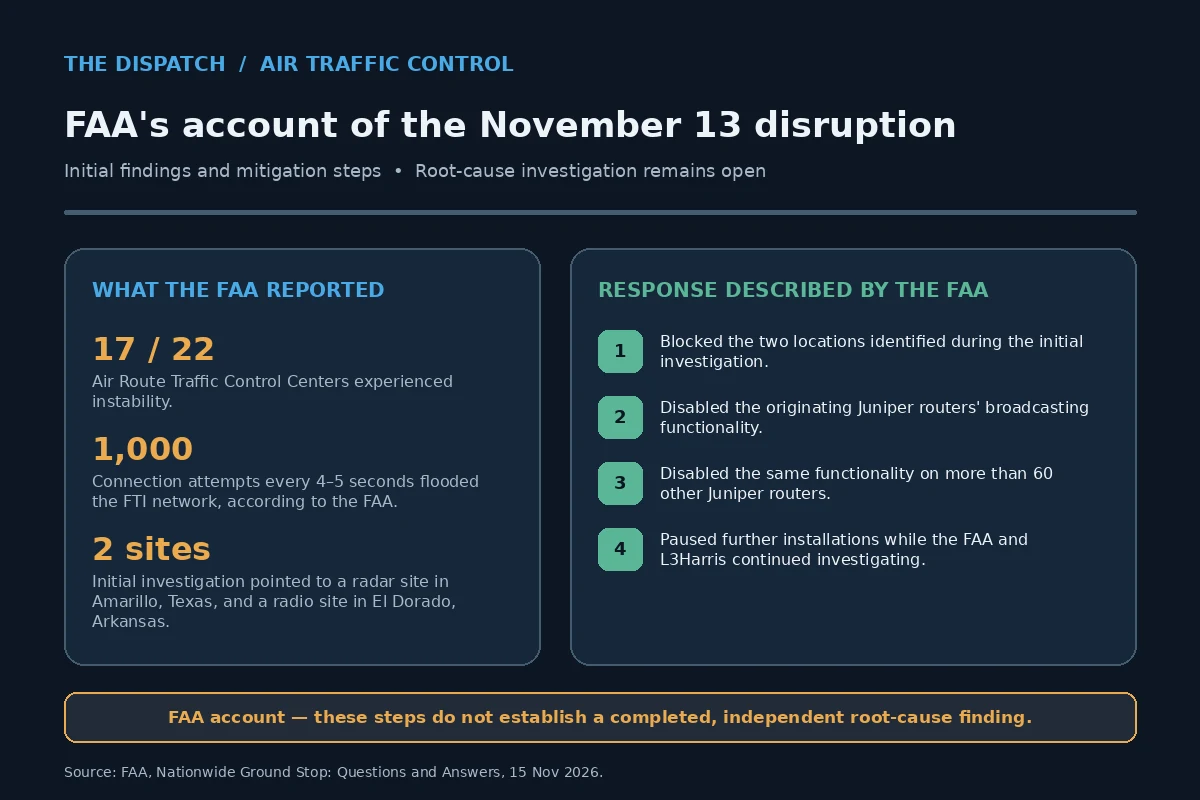
Diagram based on the FAA’s November 15 Q&A; the agency said its investigation remained ongoing.
The agency said the system was stable and air traffic resumed by 8:15 p.m. Eastern Time. It reported approximately 12,462 flight cancellations that day, including 9,082 by major airlines, while cautioning that not all cancellations were directly caused by the ground stop. The FAA said approximately 3,500 aircraft landed safely and that safety procedures remained in place throughout the disruption.
The infrastructure debate has continued in Congress. A November 16 letter from Senate Commerce Committee leaders, citing information supplied to their offices by L3Harris, said the copper-to-fibre transition involved 3,648 routers, of which 400 had been installed and 69 were operational at the time of the letter. The senators asked the FAA and Transportation Department to explain the failure and the safeguards intended to prevent a recurrence. Those figures are the committee’s stated understanding of information from the contractor, not an independent audit of the rollout.
Bank and NSA disruptions had different explanations
JPMorgan Chase said on November 16 that a software bug in its on-premises hardware systems was slowing some transaction processing, according to Reuters’ report. The bank said there was no evidence the issue was cyber-related and that customers could still access their accounts and funds. It warned that other banks might experience delays when they were processing transactions involving JPMorgan. Reports from customers described problems with some online services, but the available evidence does not support a broad claim that Americans were locked out of cash or retirement accounts.
The NSA’s internal network, known as NSA Net, experienced intermittent disruption during scheduled maintenance beginning November 17. The agency said some internal systems were affected but mission-critical capabilities remained operational. DNI Clayton later linked the problem to urgent software patching after vulnerabilities in PHP were identified. He said some systems did not restart as expected after patching. The network disruption was reported resolved on November 20, although the exact start and restoration times were not publicly established in the material reviewed.
The NSA had urged organisations to apply patches for the PHP vulnerabilities in its October 21 advisory. That context matters: patching is a security measure, but changes to complex systems can still create availability problems when components fail to restart or hand off work as expected.
Trump’s $50.1 billion request is broader than one ageing system
At his November 20 press conference, Trump said the air traffic control system was “55 years old and older” and described it as ancient. He said the administration was seeking about $50 billion from Congress to build a new system.
The Department of Transportation’s formal November 17 request is for $50.1 billion. It allocates $10.1 billion to digital architecture and telecommunications, $10 billion to airport infrastructure, $10 billion to airport terminals, $10 billion to five consolidated Air Route Traffic Control Centers and $10 billion to build or improve up to 140 control towers.
The department says the five new centres would replace the existing 22, and that the last of those existing centres was built in 1969. That is important context for Trump’s age comparison, but it does not mean every component of the national air traffic control system is 55 years old. The system includes equipment and facilities of different ages, and the FAA says its November disruption involved legacy telecommunications equipment and a router-related investigation.
The $50.1 billion is an administration request to Congress, not a completed appropriation. The department also says $12.5 billion in previously enacted funding is already supporting modernisation work.
A leadership change with a documented difference in backgrounds
Cairncross was confirmed by the Senate as National Cyber Director on August 2, 2025. His public biography lists senior roles in Republican Party operations, election law, legal and compliance work, the White House and the Millennium Challenge Corporation. They do not list a career as a technical cybersecurity executive.
Davies, by contrast, has a documented corporate cybersecurity background. The Department of War’s official biography says she served as chief information security officer at Unilever and held technology and cyber roles at Estée Lauder, Barclays Africa, Hewlett Packard Enterprise and Siemens. It describes her as having nearly two decades of executive experience spanning cybersecurity and enterprise technology.
Those biographies show a difference in professional experience; they do not, by themselves, establish either person’s performance in the National Cyber Director role. Before Cairncross’s departure, CBS News reported that multiple sources said he had been fired and that some officials believed he lacked the expertise for the position. ABC News reported a similar assessment from one source. Trump’s public explanation was that he did not think Cairncross was good enough, without providing a detailed performance assessment.
The accounts of the departure also changed over time. Axios initially reported that two sources described it as amicable. CBS and other outlets later reported that Cairncross had been fired, and Trump publicly confirmed the dismissal on November 20. The White House’s announcement of Davies did not provide a detailed account of the internal decision-making or connect the dismissal to any particular outage.
The White House says Trump has named Davies to lead ONCD. Several news reports describe her as taking the job in an acting capacity while a permanent appointment awaits Senate confirmation; the White House announcement itself does not spell out that interim arrangement.
What the evidence does—and does not—show
The outages raise legitimate questions about the resilience of critical infrastructure, the risks of maintenance and software patching, and the ability of federal agencies and private operators to recover when interconnected systems fail. They do not establish a coordinated cyberattack, and the incidents should not be merged into one technical failure.
The leadership change is confirmed. Trump’s stated reason is that he did not consider Cairncross good enough for the role. The public record reviewed for this story does not establish that the outage cluster caused the firing, nor does it show that all of the disruptions shared a common cause.
Reporting cutoff: 2026-11-21, 02:19 UTC.
AI-assisted content
This story was drafted and/or edited with AI assistance and reviewed before publishing.